
Introduction: The Pinnacle of Global Football
The FIFA World Cup stands alone as the most prestigious and widely watched sporting event on the planet. Every four years, it captures the imagination of billions, uniting nations in a shared passion for the beautiful game. This tournament is where legends are forged, dreams are realized, and history is written on the pitch. In this comprehensive guide, we will explore the rich history, iconic winners, and enduring magic of the FIFA World Cup, delving into what makes it the ultimate prize in football.
The Origins and Evolution of the Tournament
The idea for a global football championship was spearheaded by Jules Rimet, then president of FIFA. The first official FIFA World Cup was held in 1930 in Uruguay, a nation chosen as both the reigning Olympic football champion and the centenary host. Thirteen teams embarked on the journey, with the host nation emerging victorious in the final. Since those humble beginnings, the tournament has evolved dramatically. It has expanded from 13 to 48 teams (from 2026), survived cancellations due to World War II, and transformed into a colossal media and cultural phenomenon that defines eras and inspires generations of players and fans worldwide.
A Legacy of Champions: The FIFA World Cup Winners List
The roll call of FIFA World Cup winners is a testament to footballing excellence. Brazil holds the record with five titles, famed for their jogo bonito style. They are followed by Germany and Italy with four wins each, showcasing European tactical prowess. Argentina, fueled by the genius of Maradona and Messi, has lifted the trophy three times. France and Uruguay have two titles, while England and Spain have each claimed one historic victory. Each winning nation has etched its unique story into the fabric of the sport, creating a legacy that new teams aspire to join with every passing edition.
Iconic Moments That Defined Generations
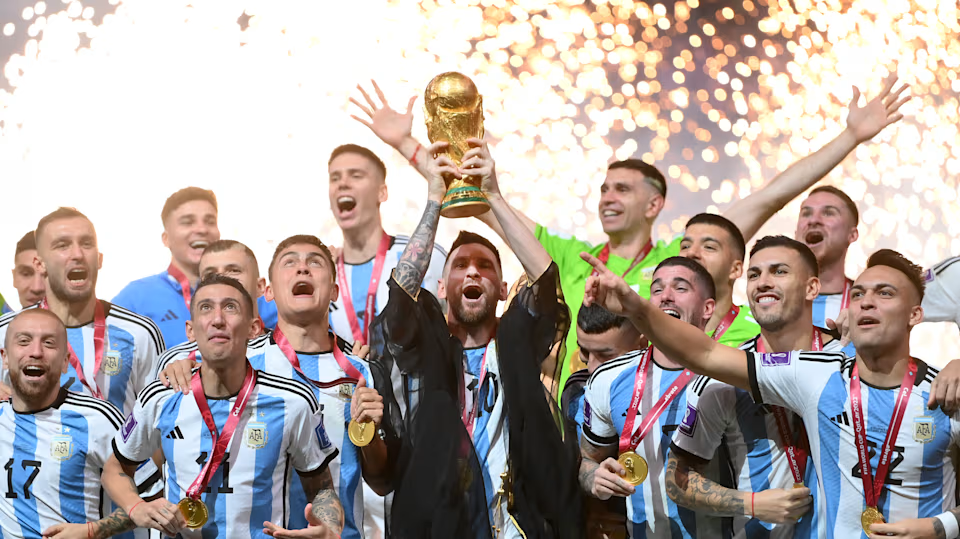
The World Cup’s history is punctuated by moments of sheer brilliance and drama. From Geoff Hurst’s controversial “Wembley Goal” in 1966 to Diego Maradona’s “Hand of God” and “Goal of the Century” in 1986, these instances live on in folklore. Zinedine Zidane’s headbutt in the 2006 final and Andrés Iniesta’s last-minute winner in 2010 are modern examples of the tournament’s high-stakes emotion. More recently, Lionel Messi finally lifting the trophy in 2022 provided a storybook ending to a legendary career. These moments transcend sport, becoming shared global memories.
The Road to Glory: Qualification and Host Nation Impact
Qualifying for the World Cup is a monumental achievement in itself. Over 200 national teams compete across six confederations for the coveted final spots. The journey creates its own heroes and heartbreaks, from tiny nations achieving historic firsts to footballing giants facing shocking eliminations. Meanwhile, the role of the host nation is crucial. Hosting the tournament demands immense infrastructure investment but offers a chance to showcase culture on a global stage. The host’s performance, like South Korea’s stunning run to the semi-finals in 2002, can also electrify an entire country and leave a lasting legacy for domestic football.
The Future: 2026, 2030, and Beyond
The future of the FIFA World Cup is set to be bigger than ever. The 2026 edition, to be hosted jointly by the USA, Canada, and Mexico, will be the first to feature 48 teams, promising more inclusivity and global representation. The 2030 tournament is poised for a unique historic celebration, with a centenary bid spanning three continents. Looking ahead, discussions around hosting cycles, format changes, and the tournament’s place in a crowded football calendar continue. One thing remains certain: the World Cup will continue to evolve while maintaining its status as football’s undisputed grandest spectacle.
Frequently Asked Questions (FAQs)
Which country has won the most FIFA World Cups?
Brazil holds the record for the most FIFA World Cup wins, with a total of five championships (1958, 1962, 1970, 1994, 2002).
Where and when will the next FIFA World Cup be held?
The next FIFA World Cup will be held in 2026. It will be jointly hosted by 16 cities across three nations: the United States, Canada, and Mexico.
How many teams play in the FIFA World Cup?
Currently, 32 teams compete in the final tournament. However, this will expand to 48 teams starting with the 2026 World Cup in North America.
Who is the all-time top scorer in World Cup history?
The all-time top scorer is Germany’s Miroslav Klose, who scored 16 goals across four tournaments (2002, 2006, 2010, 2014).
How does the World Cup qualification process work?
Teams compete within their continental confederations (e.g., UEFA in Europe, CONMEBOL in South America) in a series of group stages and playoffs to earn a spot in the final tournament. The host nation(s) receive automatic qualification.
Conclusion
The FIFA World Cup is more than just a football tournament; it is a global festival of unity, passion, and unparalleled sporting excellence. From its historic origins to its ever-evolving future, it captures the world’s attention like no other event. As we look forward to the expanded format in 2026 and beyond, the dream of lifting the iconic trophy will continue to drive nations and inspire new generations. Stay tuned to our website for the latest news, in-depth analysis, and complete coverage of every step on the road to the next FIFA World Cup.